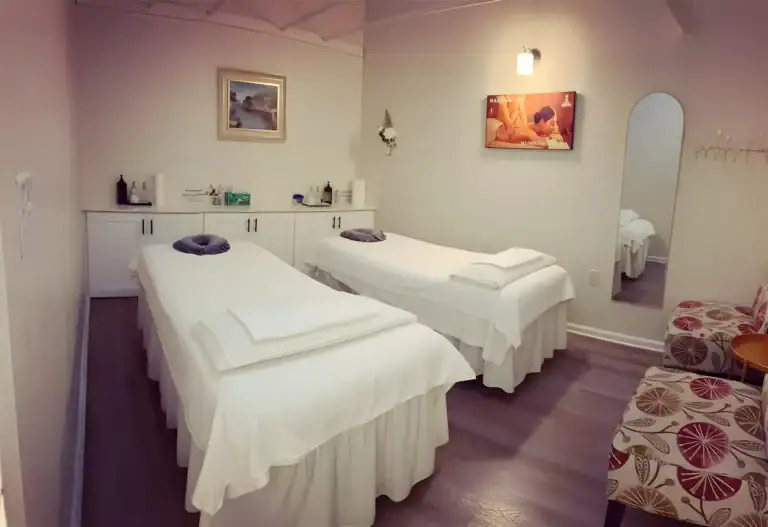
Massage works on the muscles and soft tissue of your low back, glutes and hips, and it may give short-term relief from low back pain. It hasn’t been shown to change what is causing the nerve pain. Little high-quality research has looked at massage for sciatica specifically, and the closest evidence, from studies of low back pain, is rated low or very low certainty. Leg pain that is new, severe, getting worse or paired with red-flag symptoms needs a doctor first, and So Young Day Spa is a spa, not a medical provider, so we can’t tell you what is behind your pain.
Some leg pain is an emergency, and it belongs in an emergency room long before it belongs on a massage table. The signs in the box in this section can point to cauda equina syndrome, a nerve emergency in the lower spine. Cleveland Clinic says to go to the emergency room immediately when they appear, because waiting can risk lasting damage. In the United States that means the emergency room or 911, and the massage waits.
Go to the emergency room now if you have any of these
This is the emergency-room list. If any sign below applies to you, get emergency care first and let the massage wait.
Not every warning is an emergency, but several still put a doctor ahead of a massage. The National Institutes of Health’s back pain guidance lists back pain that hasn’t improved after a few weeks, or that comes with numbness or tingling, leg weakness, trouble urinating, fever, unexplained weight loss, or severe pain that doesn’t improve with medication. It also lists back pain after a fall or injury. The NHS, the UK’s health service, adds pain that is getting worse or stopping your normal activities. Pregnancy is another reason to ask your doctor or midwife before any massage for leg pain.
Not all leg pain is sciatica. A swollen, tender leg that is painful to touch is a symptom listed for a blood clot in the leg (deep vein thrombosis), and the National Heart, Lung, and Blood Institute says to call a provider right away. Whatever the cause, a doctor should look at new, severe or worsening leg pain before you book a session.
Sciatica is a symptom of a problem along the sciatic nerve, and the cause is what a doctor diagnoses. The sciatic nerve is the long nerve that runs from your lower back through the buttock and down the leg. The NHS describes sciatica as pain, sometimes with tingling, numbness or weakness, that usually affects the buttock and back of one leg. It says the most common cause is a herniated disc, also called a slipped disc, where one of the soft cushions between the bones of your spine presses on a nerve. Narrowing of the spine, a slipped spine bone and injury can also cause sciatica.
Massage acts on muscle and soft tissue, and it isn’t aimed at a disc or a narrowed spine. That is why finding the cause matters. Many people improve within weeks to months, some take longer, and sciatica can come back, as the NHS notes.
Massage for sciatica has little high-quality research, and the low back pain evidence points to short-term benefit at low or very low certainty. The nearest evidence is a 2015 Cochrane review of massage for non-specific low back pain, which pooled 25 trials with 3,096 people. It found short-term benefit for pain and function compared with inactive comparison groups, such as sham treatment or no treatment, but not over the long term. The authors graded the evidence low or very low and said they have “very little confidence” that massage is an effective treatment for low back pain. No serious adverse events were reported in those trials, and increased pain occurred in 1.5% to 25% of participants.
Those studies were about back pain, not specifically sciatica, so applying them to pain that travels down a leg goes beyond what they measured. The American College of Physicians’ 2017 guideline lists massage among the options for low back pain that hasn’t become long-lasting, based on low-quality evidence. Its news release also says the evidence was “insufficient or lacking” to determine treatments for radicular low back pain, which means pain that radiates down a leg. The UK’s National Institute for Health and Care Excellence (NICE) takes a different angle. It says to consider manual therapy, including soft tissue techniques such as massage, for low back pain with or without sciatica, but only as part of a package that includes exercise. Guidelines differ on where massage fits.
Two 2025 reviews of non-surgical sciatica treatments, one on acute and subacute sciatica and one on chronic sciatica, rated the evidence for non-surgical treatments as very low confidence.
A tight deep buttock muscle called the piriformis can irritate the sciatic nerve in some people, but this is uncommon and sometimes over-diagnosed, and Cleveland Clinic lists massage among the complementary options for piriformis syndrome.
Put together, massage may give short-term relief from low back pain. It has not been shown to change the cause, and a doctor decides what the cause is.
So Young Day Spa offers two firm-pressure massage styles, and they differ in how the pressure is applied.
Deep Tissue Massage uses slow, firm, sustained pressure on deeper muscle and connective tissue, and it can feel intense on tight muscles. Pressure Point Massage uses firm, rhythmic pressure, with kneading, rolling, pressing and compression along muscle groups.
The National Center for Complementary and Integrative Health says the risk of harm from massage appears low, though rare serious side effects such as a blood clot, nerve injury or bone fracture have been reported, and some of those cases involved vigorous types such as deep tissue massage or people at higher risk. So choose the pressure by how your leg responds, and say so during the session. Your licensed massage therapist asks about problem areas, injuries and pressure preference before you start, checks in during the session and adjusts when you ask. If firm pressure feels like too much for a painful leg, Swedish massage uses lighter pressure, and this post on how deep tissue and Swedish compare can help you decide.
The most useful thing you can tell a therapist is where your pain travels. The list in this section has the rest of what to mention, so you don’t have to remember it in the moment.
Check with your doctor before booking if you have a diagnosed disc problem, are pregnant (ask your doctor or midwife), take blood thinners or have had a recent injury.
During the session, speak up if pain shoots down your leg or numbness or tingling appears, and tell your therapist right away if the pressure is more than you want. To ask about a session, call (469) 988-9050, and mention where your pain travels when you call or when you arrive.
What to tell your therapist
The guidance we read doesn’t name a winner between massage and chiropractic care. NICE puts spinal manipulation (a technique chiropractors often use), mobilization and soft tissue work such as massage under a single manual therapy recommendation, and only as part of a package that includes exercise. We can’t point to a head-to-head comparison. Your doctor or a physical therapist can help you choose, and either option comes after having your leg pain evaluated, not in place of it.
Keep doing your normal activities as much as you can, and avoid long stretches of sitting or lying down. The NHS says moving may hurt but isn’t harmful. If your work has you sitting or driving for hours, building in breaks fits that advice. Exercises and stretches are a question for your doctor or physical therapist. If your symptoms match the warning signs earlier in this post, get medical care instead.
If your doctor is comfortable with you trying massage, call (469) 988-9050 to ask about a session at So Young Day Spa in Plano. Tell whoever answers, or your therapist when you arrive, where your leg pain travels. Any relief may be short term, so think of a session as one part of your plan, alongside staying active and whatever your doctor has recommended. If your symptoms get worse or new ones appear, go back to your doctor before you book again.
