Massage may ease back pain for a short time, as one part of a plan. The American College of Physicians lists massage as an option for acute and subacute (recent) low back pain, based on low-quality evidence. A Cochrane review of 25 trials found improvement in the short term only, and its authors said they had very little confidence that massage is an effective treatment. Where the studies do find a benefit, it’s small to moderate.
Massage doesn’t replace medical care, and some back pain calls for a doctor before a massage table. If yours comes with any warning sign, see a doctor first. The list is in the next section.
Certain warning signs mean you should see a doctor before you book any massage. Medical sources such as Mayo Clinic, NIAMS and MedlinePlus between them name the warning signs listed below.
Get medical care right away if your back pain:
Mayo Clinic says to seek immediate care for these three. The rest of the list below is a reason to see a doctor before you book.
Get medical care first if your back pain:
Back pain can also come from outside the spine, such as kidney problems (NIAMS and MedlinePlus), which is why unexplained or severe pain deserves a doctor’s look.
Talk with your doctor before you book if you:
Mayo Clinic’s massage guidance says to talk with your healthcare team first if you take blood-thinning medicine, recently had a blood clot in your leg, or have severe osteoporosis. The list above is a little broader than Mayo Clinic’s. If you’re unsure, the National Center for Complementary and Integrative Health (NCCIH) says to discuss your concerns with your health care provider, and not to use massage to put off seeing one.
NCCIH also says the risk of harm from massage appears to be low, with rare reports of serious problems. When you check in with your therapist, mention anything from either list.
Massage for lower back pain shows a small to moderate, mostly short-term benefit in some trials, based on low to very low-quality evidence. Start with how the research sorts pain by length. Acute back pain lasts less than 4 weeks, subacute lasts 4 to 12 weeks, and chronic lasts more than 12 weeks.
For acute and subacute pain, the American College of Physicians guideline (2017) notes that most people improve over time regardless of treatment. It tells patients and clinicians to choose non-drug care such as superficial heat (moderate-quality evidence), massage, acupuncture or spinal manipulation (low-quality evidence). In its review, massage showed small to moderate improvement in pain and function. No serious adverse events were reported, though two trials noted soreness.
Chronic pain looks different. The same guideline’s first-choice list for chronic low back pain leads with exercise, multidisciplinary rehabilitation, acupuncture and mindfulness-based stress reduction, and massage isn’t on it. The World Health Organization (2023) says massage “may be offered as part of care” for chronic primary low back pain, a conditional recommendation based on very low certainty evidence. NICE, the UK’s guidance body, says to consider massage only as part of a treatment package that includes exercise.
The trials behind those statements are modest. A 2015 Cochrane review pooled 25 trials of 3,096 people and rated the evidence quality “low” to “very low”. Pain improved with massage in the short term only, and the authors wrote that they had “very little confidence” it is an effective treatment. They found no serious adverse events.
Stay as active as you can tolerate, since the NHS, Mayo Clinic and the American College of Physicians all advise against bed rest.
The research at a glance
Recent pain (acute and subacute)
The American College of Physicians lists massage as an option, on low-quality evidence.
Long-lasting pain (chronic)
Massage is not on the American College of Physicians' first-choice list.
World Health Organization and NICE
Massage may be offered as part of care (WHO, very low certainty evidence), or considered only as part of a package that includes exercise (NICE).
Cochrane review
Pain improved in the short term only, on low to very low quality evidence.
Research hasn’t identified a best massage for lower back pain. NCCIH, summarizing federal reviews, found the evidence insufficient to show that any type is more effective than the others, so choose the pressure you can relax into.
One US trial (Cherkin et al., 2011) gives a useful picture. It followed 401 adults with chronic low back pain, and both relaxation massage and structural massage did better than usual care at 10 weeks. Benefits were small by 52 weeks, and participants knew whether they were getting massage or usual care. In that trial, neither style did meaningfully better than the other.
Here’s how the spa’s three styles line up.
Swedish massage uses light to moderate pressure and long gliding strokes, which makes it friendly for a first massage.
Pressure Point Massage uses firm, rhythmic pressure, with kneading, rolling and compression along muscle groups. Hot stone thermotherapy is complimentary with every Pressure Point Massage session, at no extra charge and with no upgrade.
Deep tissue massage for back pain uses slow, firm strokes and sustained pressure on deeper muscle and connective tissue. The spa’s page says physical therapists and massage therapists commonly recommend it for chronic back pain, persistent neck and shoulder tightness and recovery from muscle strains. It can feel intense on tight spots. NCCIH notes that some of the rare serious problems reported involved vigorous types of massage, such as deep tissue massage.
| Your preference | Usually start with | What to say |
|---|---|---|
| Light to moderate pressure, or a first massage | Swedish massage | “Light to medium pressure, please.” |
| Firm, rhythmic pressure | Pressure Point Massage | “Firm is fine, and I’ll tell you if it’s too much.” |
| Slow, firm pressure on deeper muscle | Deep tissue massage | “Go slowly on the tight spots.” |
With any of the three, you can change the pressure at any point.
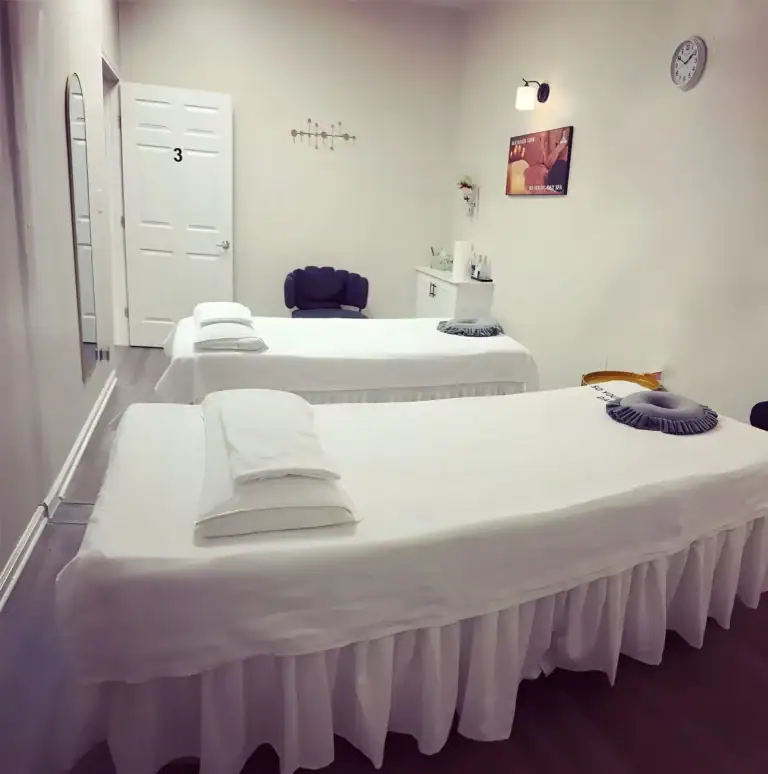
A back pain massage starts with questions, then you lie on a table under a sheet while the therapist adjusts pressure to you.
First comes intake. A licensed massage therapist asks about problem areas, injuries or sensitivities, and the pressure you prefer. Say where it hurts, how long it’s been going on, and anything from the doctor-first lists above. Mayo Clinic notes that therapists typically ask about your goals and health history to help plan your care.
Then you undress only as far as feels right for you and lie on the table under a sheet. That’s draping: the sheet covers you, and only the area being worked is uncovered. Sessions usually start face down, and you may turn over about halfway. If lying face down is uncomfortable with a sore back, you can lie on your side, and pillows or supports can help.
During the session, the therapist adjusts pressure and checks in. Massage shouldn’t cause severe pain. A tender spot can feel uncomfortable while it’s being worked, but speak up if it turns painful. Two sentences that work:
Some soreness the next day is common, especially after a first massage, and it often fades within a day or two. Mayo Clinic says it can happen depending on the type of massage. Cleveland Clinic (February 2024), quoting a licensed massage therapist, puts it at a few hours to about a day and a half, and adds that deep tissue may cause more soreness. That’s one therapist’s experience, not a study.
When the Cochrane review looked at side effects, increased pain was the most common adverse event, reported in 1.5% to 25% of participants.
See a doctor or other healthcare provider if soreness is intense or lasts longer than a couple of days.
Soreness afterward, sorted
Common
Some soreness the next day, often fading within a day or two.
Check with a healthcare provider
Soreness that is intense or lasts longer than a couple of days.
Research is thin on both upper and mid back pain and on how many sessions help.
For pain in the upper or mid back, the guidelines and trials above are about low back pain, and the short-term benefit NCCIH cites is for neck and shoulder pain. The UK’s NHS lists pain between the shoulder blades among the reasons to see a GP, so mention it to your doctor. A therapist can still work on muscle tightness you can feel, without any promise about the outcome. Pain that travels down the leg is a different topic.
For frequency, Harvard Health Publishing (2015) says it’s hard to say what the best dose and frequency of treatment are. This article gives no schedule. Ask your therapist and your doctor what fits your back.
Texas requires a license from the Texas Department of Licensing and Regulation (TDLR) to advertise or practice massage therapy, and applicants need at least 500 hours of coursework. NCCIH and Mayo Clinic both suggest asking any therapist about training, experience and credentials, and how many treatments might be needed. At So Young Day Spa, licensed, experienced massage therapists perform every massage.
Your therapist adjusts pressure whenever you ask, so you don’t need to settle on the right level in advance. Walk-ins are welcome when availability allows, and calling ahead is recommended.
Online booking is off, so to reserve, call (469) 988-9050, describe your back pain and anything from the doctor-first lists, and ask which massage fits. You can choose a time once you’ve talked with the spa.
