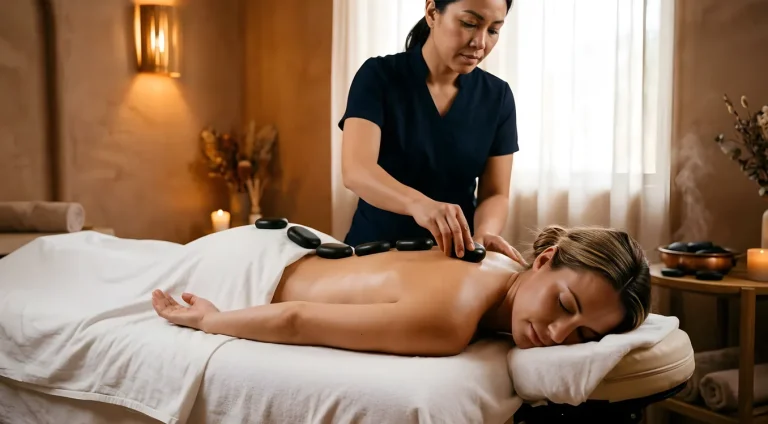
Hot stone massage may help you relax and ease muscle tightness for a while. Relaxation and short-term comfort are its best-supported effects, and even they rest on low-certainty research.
Research on hot stone massage itself is thin: a few small studies, mostly in hospital patients. People who are pregnant or have a clotting, circulation or nerve condition should check with their doctor first. This post covers what it may do, what the evidence shows, who should ask a doctor, and what to say when you call.
Hot stone massage uses smooth heated stones, usually basalt (a volcanic rock), placed on your body or moved by the therapist.
Stones that rest on the body stay put, over a sheet or towel. Working stones are in motion, and the therapist glides them along your muscles. Many appointments use both.
The stones can be added to a Swedish massage base, the gentle full-body classic and a common pick for people new to massage. Deep tissue massage is similar to Swedish but uses slower strokes and more pressure. What makes a massage a hot stone massage is the heat and the stones. How firm a session feels depends on the therapist and what you ask for.
So Young Day Spa includes complimentary hot stones with every Pressure Point Massage.
Relaxation and short-term comfort have the most support, and each comes with a caveat about how well it has been tested.
Start with relaxation. In a small study of people recovering from orthopedic surgery in Iran, those who got hot stone massage had lower anxiety scores 30 minutes later than those who got routine care. Certainty is low: these were hospital patients right after surgery, and the comparison group got routine care rather than another relaxing activity.
Warmth plus massage may loosen tight muscles for a time. Heat wraps have shown a small, short-term reduction in pain and disability from acute low-back pain, and heat can increase range of motion in healthy volunteers. The benefits of massage for pain look short-lived in reviews of low-back and neck pain. No hot stone study in healthy adults on muscle tightness was found.
Hot stone massage may improve sleep, though the evidence comes from small studies in hospital patients. In a small trial of people on dialysis, a month after 12 hot basalt stone sessions, sleep scores were better than with usual care, and the authors say the massage “may contribute” to sleep quality. A small study of people after orthopedic surgery reported better sleep as well. None of those studies looked at healthy adults.
Practitioners describe heat as bringing more blood to the skin, which is why treated skin looks warm and flushed. A small study of healthy volunteers found that five minutes of gliding massage strokes raised skin blood flow in the massaged limb. Neither the practitioner description nor the study links that to a health outcome, so it’s something you may notice, and nothing more.
The four effects at a glance
| Possible effect | What the evidence is |
|---|---|
| Relaxation | A small study after orthopedic surgery. Certainty is low. |
| Looser muscles for a time | Small, short-term results for heat and for massage. No hot stone study in healthy adults was found. |
| Sleep | Small studies in hospital patients. No hot stone study in healthy adults was found. |
| Warm, flushed skin | Something you may notice. No health outcome is linked to it. |
Most of what is known comes from research on massage in general and on heat alone, since few studies test hot stones.
Start with massage in general. A 2024 review in JAMA Network Open found 129 reviews of massage for painful conditions. Of those, 41 formally rated how certain their conclusions were, and the authors mapped 17, covering 13 conditions. In the mapped reviews, none of the conclusions was rated high certainty, seven were moderate (all favoring massage for pain), and the rest were low or very low. Conclusions with moderate or high certainty that massage beats other active treatments were rare.
Studies of heat alone, mostly heat wraps and healthy volunteers, found small, short-term benefits. Hot stone massage itself has only a few small studies, mostly in hospital patients such as people after surgery or on dialysis, and none in healthy adults looking to relax.
One trial makes a useful reality check. In a randomized trial (a study that assigns people to groups by chance) of 68 adults with generalized anxiety disorder, therapeutic massage, heat and a relaxing room all improved anxiety. The gains held at 26 weeks, and the groups didn’t differ from one another. The authors credit a general relaxation response. So some of the calm may come from being still, warm and cared for, which is still worth having. Keep in mind that these were people with an anxiety disorder.
Massage isn’t medical care. The National Center for Complementary and Integrative Health says the risk of harm from massage appears low, and advises against using it to postpone seeing a health care provider.
Three kinds of evidence
Massage in general
None of the reviewed conclusions was rated high certainty.
Heat alone
Small, short-term benefits.
Hot stone massage
A few small studies, mostly in hospital patients.
Check with your doctor first if you’re pregnant, have a clotting, circulation or nerve condition, or have fragile skin; the table below lists more.
The reason is heat. Warmth combined with reduced feeling can hide a burn, and heat may affect some conditions more than plain massage does. The sources below are about massage in general or about heat, not hot stones specifically, so they support “check with your doctor first” and none says every group must skip it.
| Group | Why heat or massage matters | Next step |
|---|---|---|
| Pregnancy | ACOG (the American College of Obstetricians and Gynecologists) says massage during pregnancy is generally fine, ideally lying on your side. It separately advises against saunas and hot tubs early in pregnancy because core temperature rises. Stones warm a small area, so the sauna point is an analogy, not a finding about stones. | Check with your doctor first, and tell the therapist you are pregnant. |
| Blood clots (for example in the legs) or blood thinners | Patient guidance from a large medical center lists both as reasons to talk to a provider before massage. Stones add heat, so extra care makes sense. | Check with your doctor first. |
| Circulation or heart conditions, high blood pressure, swelling | Practitioner sources say effects can be greater with added heat. These come from practitioners, not medical trials. | Check with your doctor first. |
| Diabetes or reduced feeling in the skin | You may not feel a burn, so the warning you’d normally give the therapist never comes. The National Institute of Diabetes and Digestive and Kidney Diseases (NIDDK) makes this point about heating pads and feet with diabetic nerve damage; stones are an analogy. | Check with your doctor first, and tell the therapist. |
| Skin conditions, cuts, sunburn, weak skin | Injured or broken skin should heal first. | Let it heal, or ask your doctor. |
| Heat sensitivity, such as multiple sclerosis | Heat can temporarily worsen symptoms in many people with MS. That is documented for whole-body heat such as hot baths, and stones haven’t been studied. | Check with your doctor first. |
| Recent or upcoming surgery, osteoporosis, tumors, implanted devices | Patient guidance from a large medical center says to speak to a provider before massage if any of these apply. | Get your doctor’s OK first. |
| Fever or contagious illness | Practitioner and consumer sources say to wait until you’ve recovered. | Wait, then go. |
| Any other health issue you’re managing | Patient guidance recommends discussing existing health issues with your doctor before treatment. | Check with your doctor first. |
ACOG’s page on getting a massage while pregnant is a good place to start if that applies to you.
A hot stone session should feel comfortable, and you should tell your therapist right away if any stone feels too warm.
Professional guidance says a stone placed on your body sits on a sheet, towel or clothing, not bare skin. Burns from hot stones are documented, and professional sources say most are preventable. The causes they name include a client who wasn’t encouraged to speak up, missing health information, improper heating and too little material between stone and skin.
A deeply relaxed client can be slow to say something, which is why speaking up early matters. You can also ask for pressure changes at any point.
Massage sessions in general usually last 30 to 90 minutes.
Not sure which massage fits? Browse the massage options to see what else is offered.
When you call, tell the spa:
Ask what to wear and how you’ll be covered, too.
Skip stacking another heated treatment right after, and drink water. If a spa day includes several heated treatments, one professional source suggests one heated treatment per six-hour window as a guideline. The water advice is practitioner guidance, not something trials have tested. Mild soreness the next day is possible after massage, and a professional association notes it can follow deeper-pressure work. If a stone felt too warm or something feels off, tell the therapist at the time.
No research sets a schedule for hot stone massage, so it depends on your goals, your budget and how you feel afterward. The American Massage Therapy Association says the benefits of massage build over time and that you can work out a plan with your therapist. In a Cochrane review of neck-pain trials, one subgroup favored 8 or more sessions of 30 minutes or longer over four weeks. That is a data point for neck pain only, not hot stones.
The research doesn’t show that massage flushes out toxins. In one small experiment, 12 people did strenuous handgrip exercise, and massage afterward reduced blood flow to the forearm and slowed lactate removal compared with resting. A massage may feel good, and that is a separate claim from flushing anything out.
Hot stone thermotherapy is complimentary with every Pressure Point Massage session at So Young Day Spa, with no extra charge and no upgrade needed. Smooth heated basalt stones are placed on key points of the body to warm muscles before and during the massage. Pressure Point Massage applies firm, rhythmic pressure and kneading.
Before the session starts, the spa’s licensed therapists ask about your goals, problem areas, injuries and preferred pressure. You can ask for more or less pressure at any point.
If any condition in the table above applies to you, check with your doctor first, then say so when you call.
The spa is open 10 AM to 9:30 PM, seven days a week, at 280 Legacy Dr #104, Plano, TX 75023.
Call (469) 988-9050, then choose a time for a Pressure Point Massage, and mention any health conditions. Walk-ins are welcome when availability allows, and calling ahead is recommended.
