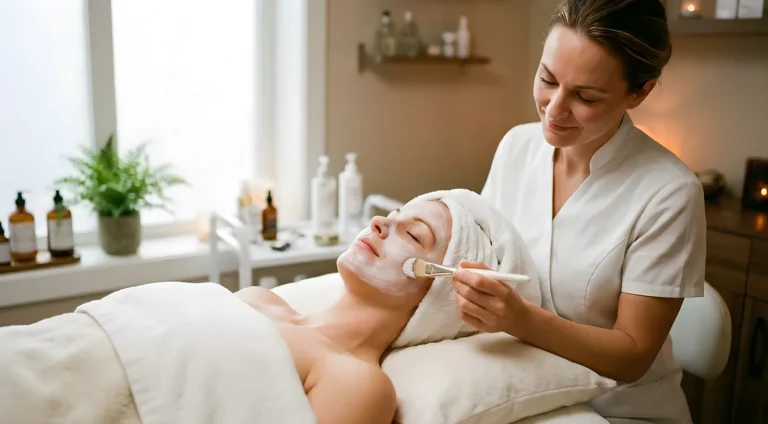
About every four to six weeks is a common starting point for a professional facial, and many estheticians suggest it for healthy skin. Treat it as a guideline, because how often you should get a facial depends on your skin type, what you’re working on, the products you use and how your skin reacts. Spas and skin clinics repeat the four to six week figure, and no study we found tests it. This is general information. If you have persistent acne, rosacea or eczema, or you use prescription skin medication, ask your doctor or dermatologist first (more on that below).
The four to six week figure appears to rest on practitioner habit and a rough link to skin renewal.
One esthetician quoted by Cleveland Clinic recommends every four to six weeks and ties it to the skin’s natural cycle, and many spas and skin clinics repeat the range. Skin renewal, the way your outer layer replaces itself, takes roughly a month or more. Estimates for the whole outer skin (the epidermis) run from about 39 to 48 days (Iizuka, 1994), and the surface layer alone turns over in about 20 days in young adults, lengthening with age (Grove and Kligman, 1983). No research ties either figure to a facial schedule.
Four to six weeks is a sensible first setting to adjust from.
Skin type, the products you use and what you’re working on all move the gap, and the table shows which way each tends to push.
| Situation | Which way it tends to push | Why, in plain words |
|---|---|---|
| Oily or congested skin | A little closer together | Congestion is what a deeper-cleaning facial targets, so some practices suggest shorter gaps for a stretch. |
| Dry or dehydrated skin | A little farther apart | Practices quote anything from monthly to every 6 to 8 weeks, so treat it as a starting point. |
| Sensitive or reactive skin | A little farther apart | One dermatology practice suggests every 6 to 8 weeks for sensitive skin. |
| Skin using prescription or strong active products | Ask first | Retinoids and benzoyl peroxide can make skin more sensitive. |
| Skin that feels fine and wants simple maintenance | Around four to six weeks, or a bit longer | Once concerns are managed, you may be able to stretch visits further apart. |
Age is a reason to check in on your skin’s current condition. The Grove and Kligman study also found that the outer layer of skin takes more than 10 days longer to renew in older adults, with a sharper drop after about 50. Nothing links that to a facial interval, though, and one skin care practice suggests every three to four weeks for mature skin. So how often you should get a facial in your 20s, 30s, 40s or 50s depends on how your skin looks and behaves now, and an esthetician can assess that better than a decade can.
Budget is a real factor in how often you go. Cleveland Clinic notes that facials are typically not covered by insurance, so spacing visits or alternating a simpler visit is a legitimate choice. Whatever your schedule, a facial doesn’t replace daily sunscreen. The American Academy of Dermatology (AAD) recommends SPF 30 or higher, broad-spectrum, even on cloudy days and in winter.
The takeaway
Treat four to six weeks as where you begin. Your skin type, your products and how your skin responds decide where you land.
Ask a doctor or dermatologist before setting a facial schedule if any of the following describe you.
Estheticians care for skin cosmetically, and they can’t diagnose or treat skin conditions. The AAD notes that prescription retinoids, retinol and benzoyl peroxide can make skin more sensitive or peel, and that exfoliating on top of them may worsen dryness or breakouts. If you use one, tell your esthetician and ask the doctor who prescribed it how to time your products around a visit. This is general information, not medical advice.
Before you book
Have these ready for your esthetician and your doctor:
Some estheticians suggest a run of closer visits while skin is congested or working on a specific concern, then a maintenance schedule once it settles.
The same Cleveland Clinic source says that once issues are managed, you may be able to stretch treatments further apart. One dermatology practice suggests every three to four weeks for oily skin, which is that practice’s view. For persistent acne, go back to the dermatologist point above. Another dermatology practice describes maintenance as monthly, every other month or seasonal, depending on the person.
A closer-together run can mean a deeper-cleaning facial first and a simpler maintenance facial after. So Young’s facial menu lists the five facials and what each one is for.
Redness, irritation and new breakouts after visits or new products can be signs your skin needs more room between treatments.
The AAD says over-exfoliating can leave skin red and irritated. It also notes that trying new acne treatments too often can irritate skin and cause breakouts. One dermatology practice says too-frequent facials may disrupt the skin barrier (the outer layer that helps hold moisture in and irritants out).
Skip or space out your next visit, simplify home care to a gentle non-abrasive cleanser, a moisturizer and sunscreen, and tell your esthetician what happened. Breakouts right after a first facial may be temporary. The Cleveland Clinic esthetician says they should ease within a week or two, though that rests on one esthetician’s account. Contact a doctor if redness, irritation or breakouts persist, or if anything is severe.
Redness after a facial is common and, according to one dermatology practice, can fade in a few hours or last a day or two.
For that reason the same practice advises against booking a facial the day of or the day before a big event, and Cleveland Clinic’s article says a first facial right before a photo-worthy event isn’t a good idea. If you’d like to try a new type of facial, consider doing it a few weeks before a big date so you can see how your skin reacts.
Seasonal changes may matter more for your home care than for your facial schedule. Dry winter air can leave skin needing more moisture, and the AAD suggests moisturizing, keeping showers short and warm, and using a humidifier. A hydration-focused or gentler facial may suit some people better in dry months, though no source we found ties facial frequency to a season.
Start at about a month, keep short notes after each visit, and adjust after two or three visits based on what you see.
If irritation or breakouts persist, check with a doctor. A So Young esthetician can look at your skin and talk this through with you: call (469) 988-9050.
We didn’t find a reliable published figure for how long facial results last. How long they last varies with your skin, your home care, sun exposure and the type of facial. Your own notes are the best way to find your answer.
A facial cleanses and exfoliates the skin, and many people find it relaxing. Evidence for specific skin outcomes is limited. Healthline says limited studies suggest some facial types may help acne, and many home-mask benefits rest on anecdote. A facial doesn’t replace daily sunscreen or medical care for a skin condition.
Bring your notes, plus a list of any medications and skin products you use, to your esthetician so the plan reflects how your skin has actually behaved. You can see the facials we offer at So Young Day Spa on our facials page, and the contact page has our address and hours. If you’re thinking about a massage as well, the massage options are on their own page. To reserve, call (469) 988-9050.
